Line up.
Lights… shadow!
Something special happens when the Sun, Earth, and Moon line up just right.
Choose Solar eclipse. Slide the Moon onto the middle of the path.
Tap a planet or its name to discover a fact • Sizes and distances are not to scale
Make a shadow together
Slide the Moon into the middle of the dotted path.
Make a solar eclipse
Choose Solar eclipse. Slide the Moon onto the middle of the path.
Take your time. You can try as many times as you like.
Window into eclipses
Explore solar and lunar eclipses. Pick a picture to see what happens when shadows line up.
Three ways to see a solar eclipse
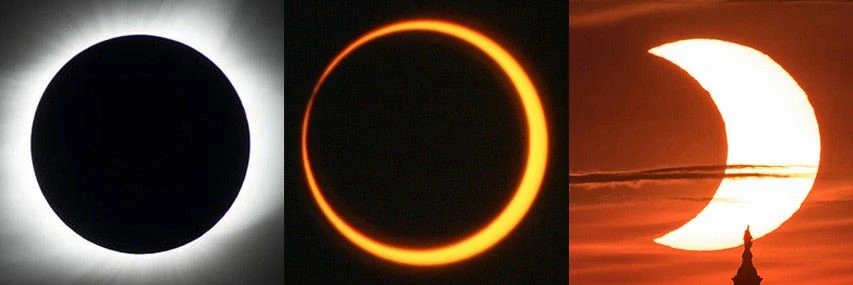
Left: total — the Moon covers the Sun’s face. Middle: annular — a bright ring remains. Right: partial — only part is covered.
Three photographs shown side by sideThese are different eclipses, not steps of one eclipse. An annular eclipse happens when the Moon looks too small to cover the Sun.Image credit: NASA / MSFC / Joseph Matus; NASA / Bill Dunford; NASA / Bill Ingalls · View originalA solar eclipse happens when the Moon’s shadow falls on Earth. A lunar eclipse happens when the Moon moves into Earth’s shadow. The Moon’s tilted orbit usually misses the shadows.
Eyes stay safe: never look directly at the real Sun.