For families & teachers
Moon phases for kids: interactive model & free worksheet
Suggested ages 5-8, with adult support. Free to use. No account or email needed. Use together on one shared screen.
The Moon stays round. We see different amounts of its sunlit half as it travels around Earth. Those changing views are called Moon phases.
Try the adventure Worksheet + 10-minute lesson ↓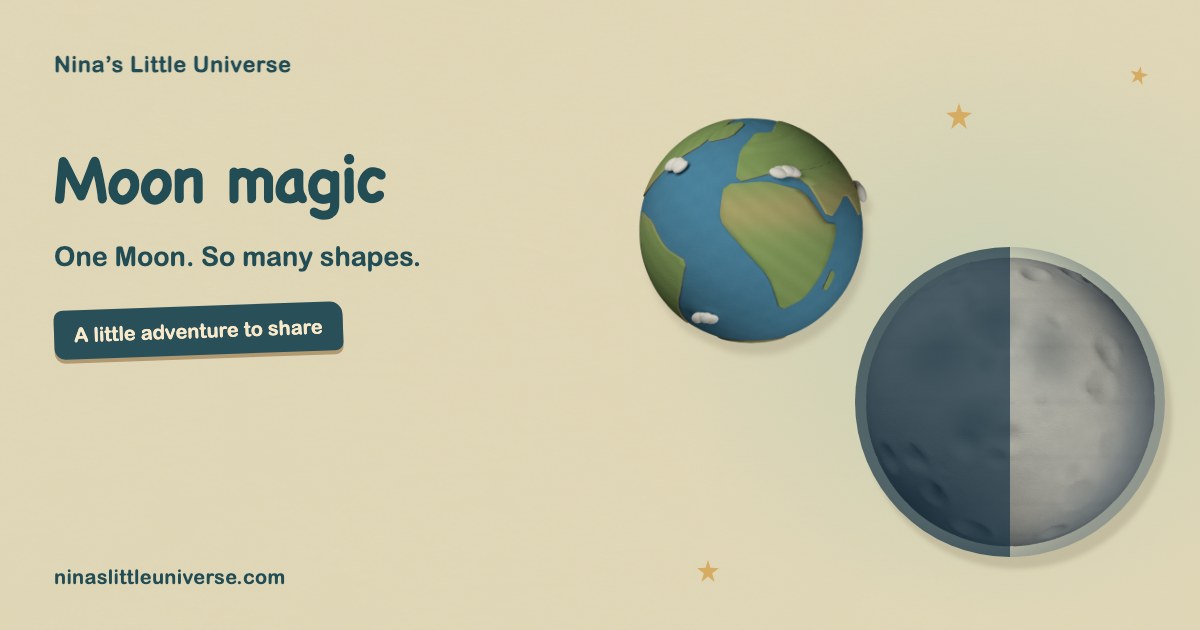
The Moon does not make its own light like the Sun. It reflects sunlight. Usually, one half is lit, but from Earth we do not always see that whole bright half. A crescent shows a little of it; a full Moon shows the bright half facing us. At new Moon, the sunlit side faces mostly away from Earth. The repeating pattern from one new Moon to the next takes about 29.5 days.
Explore together
- Open Moon magic. Notice the Sun, Earth and Moon before moving anything.
- Move the Moon around Earth and watch how its appearance from Earth changes.
- Find a crescent and then a full Moon. Make a prediction about what you will see as the Moon continues around.
One thing to remember
Ordinary Moon phases are not Earth’s shadow falling on the Moon. That happens during a lunar eclipse. Try noticing the Moon outdoors on several evenings and drawing what you see. Clouds and the time of day may make it hard to find, and the Moon can sometimes be visible during daytime too.
Science reference: NASA ↗Ready for your classroom
A ten-minute lesson to try together
Suggested ages 5-8, with adult support
Two A4 pages: a student worksheet, then the lesson and suggested answers. Print page 1 for children. Black-and-white friendly.
- What children will learn
- Children can describe Moon phases as different views of the Moon’s sunlit half, while the Moon itself stays round.
- What you need
- One shared screen, a pencil, and page 1 of the worksheet for each child or pair. No colour printing needed.
- 0-2 min
Remember a Moon
Ask children to describe a Moon they have seen. Was it a thin curve, a half circle or a full circle? Ask whether they think the Moon itself changed shape.
- 2-5 min
Find three views
Open Moon magic and pause the automatic movement. Move the Moon around Earth with the paper tab. Stop at a crescent, a half Moon and a full Moon. Point to the sunlight and compare the view from Earth at each stop.
- 5-8 min
Draw what looks dark
Children shade the dark parts of the three worksheet circles, leaving the bright parts white. They can copy the paused model. Invite a drawing or spoken answer about why the view changes, then read the final choice aloud.
- 8-10 min
Explain the change
Ask: Did our Moon shrink, or did the bright part we can see change? Listen for a changing view of reflected sunlight. If a child says Earth’s shadow makes the phases, distinguish ordinary phases from a lunar eclipse.
Suggested answers & ways to adapt
- Crescent: leave a thin bright curve. Half Moon: leave half white. Full Moon: leave the whole circle white. Either left or right illumination is acceptable for the first two drawings.
- Accept the idea that we see different amounts of the sunlit half as the Moon travels around Earth. The Moon reflects sunlight.
- The correct final choice is The Moon stays round. Earth’s shadow causes a lunar eclipse, not the ordinary phase cycle.
For younger children, complete just one circle and explain aloud. For an extra challenge, ask them to find two different positions that show a half Moon and compare which side looks bright.